People, Power, and Profits: Progressive Capitalism for an Age of Discontent
Download iOS / Download Kindle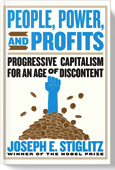
We all have the sense that the American economy - and its government - tilts toward big business, but as Joseph E. Stiglitz explains in his new book, People, Power, and Profits, the situation is dire. A few corporations have come to dominate entire sectors of the economy, contributing to skyrocketing inequality and slow growth. This is how the financial industry has managed to write its own regulations, tech companies have accumulated reams of personal data with little oversight, and our government has negotiated trade deals that fail to represent the best interests of workers. Too many have made their wealth through exploitation of others rather than through wealth creation. If something isn’t done, new technologies may make matters worse, increasing inequality and unemployment.
Stiglitz identifies the true sources of wealth and of increases in standards of living, based on learning, advances in science and technology, and the rule of law. He shows that the assault on the judiciary, universities, and the media undermines the very institutions that have long been the foundation of America’s economic might and its democracy. Helpless though we may feel today, we are far from powerless. In fact, the economic solutions are often quite clear. We need to exploit the benefits of markets while taming their excesses, making sure that markets work for us - the U.S. citizens - and not the other way around. If enough citizens rally behind the agenda for change outlined in this book, it may not be too late to create a progressive capitalism that will recreate a shared prosperity. Stiglitz shows how a middle-class life can once again be attainable by all. An authoritative account of the predictable dangers of free market fundamentalism and the foundations of progressive capitalism, People, Power, and Profits shows us an America in crisis, but also lights a path through this challenging time.
Creating a Learning Society: A New Approach to Growth, Development, and Social Progress
Download iOS / Download Kindle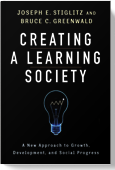
It has long been recognized that most standard of living increases are associated with advances in technology, not the accumulation of capital. Yet it has also become clear that what truly separates developed from less developed countries is not just a gap in resources or output but a gap in knowledge. In fact, the pace at which developing countries grow is largely determined by the pace at which they close that gap.
Therefore, how countries learn and become more productive is key to understanding how they grow and develop, especially over the long term. In Creating a Learning Society, Joseph E. Stiglitz and Bruce C. Greenwald spell out the implications of this insight for both economic theory and policy. Taking as a starting point Kenneth J. Arrow's 1962 paper "Learning by Doing," they explain why the production of knowledge differs from that of other goods and why market economies alone are typically not efficient in the production and transmission of knowledge. Closing knowledge gaps, or helping laggards learn, is central to growth and development.
Combining technical economic analysis with accessible prose, Stiglitz and Greenwald provide new models of "endogenous growth," upending the received thinking about global policy and trade regimes. They show how well-designed government trade and industrial policies can help create a learning society; explain how poorly designed intellectual property regimes can retard learning; demonstrate how virtually every government policy has effects, both positive and negative, on learning; and they argue that policymakers need to be cognizant of these effects. They provocatively show why many standard policy prescriptions, especially associated with "neoliberal" doctrines focusing on static resource allocations, impede learning and explain why free trade may lead to stagnation, while broad based industrial protection and exchange rate interventions may bring benefits, not just to the industrial sector, but to the entire economy.
The Price of Inequality: How Today's Divided Society Endangers Our Future
Download iOS / Download Kindle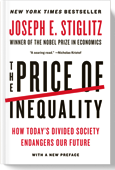
America currently has the most inequality, and the least equality of opportunity, among the advanced countries. While market forces play a role in this stark picture, politics has shaped those market forces. In this best-selling book, Nobel Prize–winning economist Joseph E. Stiglitz exposes the efforts of well-heeled interests to compound their wealth in ways that have stifled true, dynamic capitalism. Along the way he examines the effect of inequality on our economy, our democracy, and our system of justice. Stiglitz explains how inequality affects and is affected by every aspect of national policy, and with characteristic insight he offers a vision for a more just and prosperous future, supported by a concrete program to achieve that vision.